Donate to The Aniplant Project to help Cuban animals

Saturday, June 30, 2012

Ladas I Have Known


Ladas I Have Known 
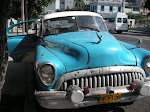
Old US made cars aren't the only cars on Cuba's highways and Havana's streets.  New taxis are Hyundais and Kias and the occasional Peugeot, and then there's the ubiquitous Lada.  The Lada 125, shown in the picture, is everywhere you look.  Made in Russia and exported to Cuba, the Lada was a natural choice for Cuba as it pivoted early on away from western imports to dependence on the Soviet Union. 
Really, it all began with Italy's giant Fiat Group Automobiles many years ago.  Fiat, it seemed, wanted to make cars everywhere in the world, and it succeeded in establishing car factories in Spain, Bulgaria, Turkey, South Korea, Egypt, India, and Russia, where Ladas, a poor man's edition of the Fiat, were made.  When Cuba fell out with the US and suffered an embargo of US goods, Russia was ready with the Lada—such as it was. 
Fiat's success in exporting its small cars around the world managed to create 15 million little slab-sided machines all over the world—a number in a class only with Volkswagen Beetles and Model T Fords.  But frankly, the Russian Ladas—at least those in Cuba—are hardly a standard of quality to wave before the world.  Still, they have survived in surprising numbers in Cuba thanks to several factors including—high car prices, low incomes, restrictions an buying new cars, and the prowess of Cuban shade tree mechanics.  Thus I have come to my theme: three Ladas I have known. 
1. The Doctor's Wheels 
On my first trip to Cuba, Christina (HSUS's Latin American Coordinator) and I met Dr. Gilbert Flietes and his charming wife.  They took us to dinner in their Lada, then about 30 years old.  It had a cracked windshield, but you could ignore the crack as it still parted the wind.  It had all of its paint and upholstery, but surely showed its age. 
Now Gilbert was one of the top thoracic surgeons in Cuba.  His American equivalent would have easily earned 1 million dollars a year and driven a Mercedes.  But in Cuba on a salary of perhaps $25 a month, even the best doctors make do with old Ladas.  The good doctor was affiliated with the Physicians Committee for Responsible Medicine, an important American animal protection group.  Gilbert and his wife had no companion animals at home, but every night, they fed two feral dogs who lived in a nearby park.  My kind of people. 
2. Taxi on a Shoestring 
I wrote about this Lada before.  We found it on a dark Old Havana street late at night after a music show we'd taken in.  The driver negotiated a 15 CUC fare to get us back to our hotel, and we set off on dark, unfamiliar streets.  The car was on its last legs—no upholstery on the doors, and a replacement diesel truck engine whooping up a racket under the hood. 
The driver stopped in a dark gas station and asked me to pay our fare, although we were nowhere near the hotel.  A little discussion revealed he was almost out of gas and needed our fare to pay for more gas and continue driving on.  Having little choice, I paid, and we eventually ended up at our hotel. 
3. Home from the Aquarium 
As we left the Havana Aquarium, there were two taxis waiting on a nearby street.  The first in line was a new Hyundai, and I thought, "We're in luck, as I told him where we wanted to go.  I was dismayed when he ushered us to the old Lada second in line.  A down and out looking young man sat at the wheel as we reluctantly filled all four empty seats.
If the car looked bad on the outside, it was worse on the inside.  The doors lacked upholstery, and the seats were recovered haphazardly in cracked old red leatherette.  The engine sounded like a bulldozer, and the driver told us to slam the doors to get them to stay shut.  He also warned us not to lean on the doors while in motion as they could fly open without warning.  To make matters worse, he didn't know where our hotel was, and I had to give him directions.
It was clear he was an illegal taxi operator.  He had no meter, no sign on the outside, and he explained he would stop and let us out a block away from the hotel just in case any police were there checking for the arrival of illegal taxis.  He did as he said, and we found ourselves on the sidewalk a block from the hotel.  As he drove past the hotel taxi stand, he looked like any other beat up old Lada private car clanking along Calzada Street. 
On a trip to Havana a traveler can hardly miss coming into contact with ancient Ladas—there are so many of them, but you'll soon learn to avoid them if at all possible. 

Les Inglis

Tuesday, April 17, 2012

Airport Adventure

Airport Adventure

You haven't really entered Cuba until you have cleared the exacting routines in the airport. In the newly remodeled, but still old terminal that US passengers use, you walk in from the apron where the planes stop, enter the building, and stop at a red line to wait for the next available immigration clerk. But the authorities are good and have provided plenty of clerks to move us opn through. My clerk was a nice young woman, who asked me to step back a pace for a camera to take my picture. As soon as that was finished, and with practically no questions, I was buzzed through to the security check and baggage area. The man waved me through the metal detector, and my sport jacket went through the x-ray in a plastic tub.

Again, there were no questions until I was suddenly free to find my two checked bags. I've always admired the way the British cue up for for lines at ticket counters, but I don't think they do it at baggage carrousels. There, and everywhere else, people get up next to the carrousel, and even if you are lucky enough to see your bag, you can't penetrate the forest of people crowded against the moving belt. Eventually through you get there, grab your bag, and turn to face more of the crowd to try to get out. There must be a better way.

And while there were plenty of immigration clerks in their little kiosks, there weren't enough baggage handlers. When the first truckload of bags from our flight was exhausted, there was a long wait while the crew went back to the plane and off-loaded more bags. As luck would have it, my second bag made the second truck with 10 minutes waiting between trucks.

You finally arrive in Cuba when your bags piled on a push cart pass by another clerk collecting baggage tags, and you're through the doors to the outside. The four of us traveling together had 14 bags on two carts, and we scanned the crowd of people meeting travelers for Nora, but could not find her. We progressed slowly to the curbside where the taxis stop without seeing her, and then it happened.

I lifted the front end of one cart and then the other in a little space at sidewalk level and turned to look back at the crowd, searching for Nora. I moved back toward most of the people. No Nora. I stepped down into a little wheelchair ramp, while looking at faces for Nora's. The next step did me in as my left foot swung forward and struck a rough spot in the pavement, pitching me forward in an uncontrolled fall toward the curb in front of me. My head hit the sidewalk and curb with a violent blow, and I felt sure I would not be able to get up again. But now the many people around was an advantage. Several grabbed my arms and body and righted me, and I felt a dizzying pain as I began to gather my bearings. Many asked if I was OK, and I said, "I think so."

An airport worker called the medics, and I was guided toward the building again, bleeding from my forehead, nose and lip. We went into a little nurse's office. Bob was with me, so I didn't worry about the bags or the others in my party. There in the nurses quarters, began 45 minutes of exams and treatment of my wounds. The pain subsided, my handkerchief was soaked with blood, and they convinced me to stop dabbing at the wounds so they could keep them sterile. The dizziness and disorientation subsided, and I eventually made my way back with a nurse guiding me to my fellow travelers. Bob was with me, and the others were still with the bags. Finally, Nora apparently had seen me but couldn't make her way through the crowd or make enough noise to catch our attention. We connected, and I was soon seated in her borrowed van, the bags were loaded, and we were off, hardly comprehending what had happened to me. I was wearing a bandage on the bridge of my nose to remind me of my airport adventure.

Les Inglis

Tuesday, April 3, 2012

I'll Stand By You

I'll Stand By You

It was 1996, and we were in Washington DC on the Mall in front of the Capitol taking part in the second national March for Animals. That event and another in 1990 was put on by the National Alliance for Animals. Washington DC is a long way to go for most Americans, but this was a very special cause for Charlene and me. It was all about moving the nation toward a more respectful attitude toward all animals. The assembled marchers were promoting the rights of animals and the protection of animals.

We were somewhat disappointed with the turnout for the march. Six years earlier the crowds were larger, their spirits a little higher. Estimating how many actually show up for a demonstration at the Capitol is a political game. If it's your demonstration, you see the attendance as higher, and if it's a group you don't like, your estimates are a little lower, so I didn't play the numbers for either march, but the first was clearly larger.

We were also concerned that another group had chosen the same day for a demonstration at the Capitol. It was a gay and lesbian group, although I can't remember the group's name. But I'll always remember what they did. It was one of those insufferably hot summer days with the temperature over 90, and humidity to match. The sun beat down on all the demonstrators as we milled around at the foot of the huge flights of Capitol steps on the west side of the building. The only drinking water around was a running garden hose laying in one of the closed off streets. I finally decided it couldn't be too dirty, having been running for more than an hour. I drank from it after a number of others had done so.

We wondered where the gay group was and worried a little that they might upstage our efforts for the animals, but we needn't have. Soon, we heard strong familiar piano chords introducing a beautiful female voice. "That's Chrissie Hynde," someone said. "I think she's here for the gays." Well, she was here for us too. At the top of the stairs, they appeared marching to the music single file down both sides of the central stairway. Leading the left side was Dan Mathews, a 6' 5" animal rights hero and Vice President of People for the Ethical Treatment of Animals. There was no question both groups were united that day, as Chrissie Hynde was sitting on Dan's shoulders belting out her megahit, "I'll Stand ByYou." The animal rights demonstrators were stricken with the friendly gesture and so moved by the soulful rock music. I wasn't the only one wiping a tear away from my eye.

When the night falls on you
Don't know what to do…

I'll stand by you.

The gays filed down the stairs and mixed in with our crowd until no one knew who was from what group. We were suddenly one big family. The haunting music was repeated until all the people were on the mall level, when Chrissie and the band found shade under one of the huge trees. Rejuvenated, invigorated, everyone knew both demonstrations had become wildly successful. I walked over by the tree and saw Chrissie there stretched out on the cool grass. I wanted to tell her how much her music meant to all of us, but, being a little shy, I stayed silent and moved on. After all, the value of her contribution was obvious.

You're standing at the crossroads
Don't know which path to choose…

I'll stand by you.

Ever since that day, whenever we hear Chrissie sing that song, Charlene and I have an emotional moment. I think that's what inspired Charlene to use "I'll Stand ByYou" for the background music for our new The Aniplant Project slideshow. It's a really artistic tribute to suffering animals everywhere. It is dedicated to World Stray Animals Day, today, April 4, 2012. To see it, if you are on our mailing list, you'll get an emailing from Charlene with a link to the slideshow. Be sure your sound is on and click the link.


Les Inglis

Sunday, April 1, 2012

Taxi Ride on a Dark Night

Taxi Ride on a Dark Night

One night on my last trip to Havana, our little group decided to take in some Cuban music at a show at the Havana Club. We made a reservation and took a taxi to Old Havana where the Havana Club puts on nightly shows. One reason I like Cuban music events is because Nora is so well connected with the entertainers. She had been adopted as a girl by María Alvarez Rios, a famous author, singer, and songwriter. The other reason is I just like Cuban music.

I was a little worried about how we would get back to the hotel, as the shows end very late in a dark, older part of town. But I needn't have worried. It turned out the Havana Club is only two short blocks from the Central Park area where the cabs are plentiful at all hours.

When the show ended, we walked out, and right away we encountered an old taxi big enough for the five of us. The cabbie said it would be 10CUC, and I agreed, even though getting to the show had only cost 6CUC. I rationalized the difference because of the late hour.

When you get in an old cab in Cuba, you are dealing with a private businessman, not a cab company. Checking the fare ahead of time saves misunderstandings and swindles, although to be fair, I think swindles are no more common in Cuba than in the US. Anyway, we piled in and started off.

In a few blocks we were in unfamiliar territory, but I still had a sense we were going in the right direction. The cab driver turned into a gas station that almost looked unattended. The driver asked me to pay the 10CUC's now so he could use it for gas. Normally I like to pay for a taxi when I get where I'm going, but judging by the condition of the car I understood how he could have started out across town without enough gas to get there, and anyway we needed gas to get back. He took the money, pumped the gas, and we got on our way again.

We got to the hotel without further incident, and I gave the driver a tip, realizing his budget was a lot tighter than mine. On reflecting about our ride later, this was a private enterprise, budding and trying to grow in the midst of one of the last bastions of Communism. Here was a guy piloting an old wreck he had probably fixed while it was up on blocks in front of his house. And there he sat on a dark, deserted street, hoping to get the jump on some of the newer fleet cabs a couple of blocks away by being right there when the show let out. Competition,—one of the bugaboos of communism—was alive and well that night in Old Havana.

Our driver was a capitalist, an entrepreneur—living by his wits and managing his resources, in this case gas and money, as tightly as he could.

I had to admire his venturesome spirit.

Les Inglis

Saturday, March 24, 2012

I Remember You

I Remember You

It had been almost exactly a year since my last trip to Cuba, and I was staying in the hotel Presidente, as I always do. After seven trips, I had begun to look upon that place as my home away from home. I knew many of the hotel employees by name, such as George the elder and George the younger, two bellmen who remember me when I show up. Frank is another bellman who remembers me, and Natasha is a waitress in one of the hotel's two restaurants. Stepping into the lobby to register for a short stay is a little like old home week.

With two dogs and six cats at home, I often miss their company when I'm away, but even in the pet department, the hotel makes me feel at home with Bigotes, a tabby cat who haunts the porches and dining room. She is always ready for a petting session, as am I. At less than half the cost of the famous Hotel Nacional my budget appreciates the Presidente too.

The Hotel Presidente is an 11 story building built in 1928. When completed it was the tallest building in Cuba—for a while at least. I like buildings of this era. Other examples mightg be the Chrysler Building in New York, the Carew Tower in Cincinnati, and the Bok Singing Tower in Lake Wales, Florida. That era was one of workmanship, no skimming on details, and high quality construction.

The Presidente housed one of Cuba's first casinos in the well-known gangster era. Today there is no trace of it, and every floor is filled with guest rooms.

Getting around in Havana is easy if you're staying at the Presidente. Cabs, vans, and buses line up along the east and south sides, and there is seldom a wait for a ride. This year, my traveling companions, Jerry, Xenia and Bob, came outside with me to get a cab, and a handsome, smiling cabbie sprung to attention and held a door for Xenia. We settled in with me in the front seat, and I told him we were headed to Central Havana, but first we had to make a stop in Vedado to pick up another lady (Nora).

The cabbie brightened and said, "I remember you. You were here last year with two Dutch women and then also we had to go to Calle I to pick up Nora." I was dumbstruck—he had remembered me for a year, my Dutch friends and Nora's name. He went on, "I had to call for Nora on my cell phone as she lives on the tenth floor." Incredible, I thought, he recalled the cell call and the floor her apartment is on.

His name was Reynaldo, and I was blown away by his ability to recall one cab ride a year before. What I wouldn't give for a memory like that! Reynaldo and I chatted until we got to our destination. I figure I'll see him again on another trip to Havana. I sure hope so, and if I do, I'm certain he'll remember me.

I always thought I had a pretty good memory, but after two encounters with Reynaldo, I'll never brag about it again. In fact, as I write these blogs, I sometimes come up short trying to remember a name. If necessary, I'll make up a name when I can't remember. I figure who will know, and it doesn't make any difference to the point of the story.

For example, in this posting, both Georges, Frank, Natasha, Jerry, Xenia, and Bob are all real names of my friends. I hate to admit it, but Bigotes and Reynaldo were christened by me when I couldn't dig up their real names from the dust bin that serves as my memory.

Les Inglis

Sunday, March 18, 2012

Subsistence

Subsistence

When I'm in Cuba, I spend most of my time in Havana, a city of more than two million people. Havana in 1958 was a modern, tourist-oriented capital city, and while it has suffered from a severe case of deferred maintenance since then, it is still like lots of other places in the world, albeit the worse for wear. But you can have a different view of Cuba if you venture into the rural areas.

I haven't seen eastern Cuba, but I have traveled a little into the western part of the island. This month we briefly visited Pinar del Rio and Viñales, a long drive from Havana. Our visit to a farm was worth discussion in these blogs.

We were near Viñales, famous for its loaf-of-bread shaped mountains (called "mogotes") and flat valley floors, giving the place an other-world flavor. One might expect a hilly transition between flat ground and mountains, but not here. The mountains have nearly vertical walls which pretty well prevent people from living on them. You find the people, instead, on the flat valley floors, and such was the setting for the farm we visited.

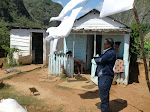
You'd be correct in calling it a subsistence farm, and it was difficult to imagine a whole family making its living on this barren land. We stopped the van on a deserted road, and saw the driveway curving up toward the small house in the distance. The driveway was too rough, so we got out of the van and walked toward the house. The bare ground of the driveway looked like the red earth of Georgia, but slightly darker.

The house may have had two rooms and a little front porch. There were a couple of sheds but no barn. Our driver had stopped here before, and he greeted the farmer. As they talked in rapid-fire, highly accented Spanish that I couldn't hope to understand, the rest of us walked around to see what kind of place this was. The wife (or possibly a daughter) was sitting on the front porch, nursing a baby, and several skinny little dogs milled around sniffing and scratching.

I discovered a large pot (more like a cauldron) sitting on a log fire behind the house. It's contents were boiling, and a burlap bag floated on the surface of the liquid in the pot. I puzzled over the burlap, and finally decided it was to suppress foaming. When I saw it, I didn't know what was cooking, but whatever it was, it was too much to be intended for the few people living in the house. It was clearly a farm product meant to be sold.

That guess proved to be right when I was told it was hot sauce, and then I saw a large carton of bottles of hot sauce filled, capped, and waiting to be sold or shipped to the city. We were told the farmer was certified by the government to bottle and sell his product.

Nora and the driver each bought several bottles of the hot sauce to take back to the city. That's the way lots of farm products make their ways to the dinner tables in Cuba. City dwellers, on trips to the country, buy farm products and take them back to give or sell to friends and relatives or possibly to be sold in the many little food stands you find in Havana. Nora and the driver were functioning as part of Havana's food supply system.

But Nora had a larger interest—the little dogs roaming about. She discovered there was no water bowl set out for them, and she told the farmer of her work in animal protection and gave a little lecture on always having water for them. She asked and got permission to treat the little dogs for parasites, and soon she was digging in her large bag for a syringe and a vial of medicine. Every dog got a dose of the medicine.

Nora and our driver bought another box of melanga root, a tough brown root that looks like something that would grow in a desert. Well, In this dry, dusty place, "desert" was a good word for the surroundings. Melanga can be peeled, fried, boiled into soup or stewed. It's a starchy, high-calorie standard part of the Cuban diet with a nut-like flavor. Once again, Nora and our driver were part of the food supply chain for Havana.

I told Charlene that I had never been on a farm so primitive before. There was no electricity, telephone, air-conditioning, or television. She said, "You haven't seen all of Kentucky, then." Well, not to be argumentative but I've seen a lot of Kentucky, and this little farm in Viñales, with strange shaped mountains in the distance was in a class by itself.

Les Inglis

Sunday, March 11, 2012

Change in the Wind

Change in the Wind

Something is different in Cuba these days. We've been hearing about reforms since Fidel Castro stepped down for health reasons a few years ago. Younger brother, Raul Castro, didn't inherit a bed of roses when he took over the reins of the Cuban government. There were food shortages, money shortages, and Cuba's ponderously slow to change, Stalin style Communist economy was being compared unfavorably with the modern Chinese economic miracle.

Based on their actions so far, Cuba isn't going to be another China, but Raul seems to know that changes have to be made, and he isn't shrinking from the task. One of the early steps was to encourage certain private businesses. A Cuban entrepreneur could set up a small 12-seat restaurant in his home and run it as a private business. Immediately thereafter, "paladares" began springing up, and today they are some of the best places to eat in Cuba. More recently the 12-seat limit was relaxed. Result: still more restaurants.

Another early move was cell phones. They are evident today even though they cost more than most people earn. A popular way to have one is to get a relative in America to subscribe for your cell phone service. Now cell phones are becoming indispensable as they did everywhere else. They save trips in a transportation-poor economy, they stimulate business, and the entire Cuban nation is moving toward being in touch.

A big change came when people could buy and sell their cars. Newer cars as well as the old 50's era American cars can be bought and sold freely today. One wonders what the old restrictions on car sales ever did for anyone in Cuba. Today, if you have a car you don't need, you can sell it and get some money, which of course you do need.

But the biggest change of all is only a few months old. In the past you didn't own your house (even if it had been in your family for generations). The state owned it, but they allowed you to arrange trades of homes with other house dwellers. It was a slow, cumbersome procedure, but that trading loophole was how Aniplant got its headquarters in 2006. But today, in one of the biggest concessions to individual liberty since the Revolution, a Cuban can sell his house or buy a different one. If he is wealthy (not likely), he can even have a second home. This is a monumental change as it has created a real estate market, and it has put money in the citizens' pockets.

Also restrictions on private businesses have been further relaxed. Sitting in a new "paladar" for lunch last week right across the street from Radio Progresso where Nora presents her weekly radio shows, we had some great local food at ridiculously low prices. While we dined, a woman came in, approached our table, and tried to sell us a bead necklace. She was more insistent than she should have been, and the owner had to show her the door. Then two men entered separately and solicited the diners to buy their CD's with Cuban music. They were polite and the owner let them pass through and leave on their own. Finally a bicyclist pedaled by with baskets full of fresh flowers.

There you have it—4 private businesspeople trying to run their enterprises—something unimaginable when I first visited Cuba in 2005.

Finally on our way out of town to Pinar del Rio last Monday, we drove through Playa, a section of Havana, for a long time.. Suddenly I realized I was seeing crews of painters, carpenters, masons, and other workmen swarming over a number of houses along our route. And I realized I had been seeing lots of such activity all over town. Well, what would you expect? When a person knows he can sell his home, he has a valuable asset, and he moves to take care of it.

Cuba has a long way to go before it has a healthy economy again, but the signs of change for the better are there to see. Indeed I saw more change in the past year than I had seen in the previous six years. People still pay high prices for food and cope with many shortages, but at least they can buy building materials to fix the front porch or paint the house.

These long overdue changes can't be anything but good.

Les Inglis