

Donate to The Aniplant Project to help Cuban animals

Monday, July 29, 2013


                                                                       Peachy


Pura Raza

Americans usually think of Cuba as having a sick economy, lots of poverty, and few luxuries.  It seems almost incongruous that Cuba could have an active group of purebred dog fanciers.  Once a year Cuba hosts a judged dog show attracting people from many other countries.

I too found the interest in purebreds somewhat surprising, but in my several trips to Cuba I have met members of the Doberman and Rottweiler clubs and the president of the Boxer club.  No matter what our foregone conclusions about Cuba might be, purebred dog fanciers abound in Cuba.

Among the 13 dogs Charlene and I have had, only three were AKC registered purebreds, and we never had the AKC certificate on any of them.  We really didn't care about the certificates, as it wouldn't have made any difference to us if our dogs were registered or not.  Still, as I gaze at my study walls where each of them has a framed photo, I can see echoes of purebred ancestors in many of them.  I use the breed names merely to describe them, not to try to distinguish their ancestry.  In the order we acquired them, let me introduce you to them:

1.     Annie was a 15 inch Beagle who adopted us when she came up out of the Ohio River banks to join us as we restored our old farmhouse.

2.     Boy was a perfect German Shepherd abandoned and starving.  We found him living under a pile of lumber in our barn.

3.     Roscoe looked a little like an Airedale with reddish wiry fur.  Charlene found him walking the road in front of our farm during a rainstorm.

4.     Yo-yo was a beautiful tri-color American Fox Hound who became the light of our lives.

5.     Spotty was a small bird dog like so many who bred casually on the farms in our area.

6.     Pepe was a black purebred miniature poodle, acquired from some people who ignored and mistreated him.  He lived with Charlene's mother for years and finally came to live with us. He lived to 16 years of age.

7.     Casey was a Wheaten Terrier, possibly purebred as we got her from a Wheaten Club rescue group.

8.     Hope was given to us by our vet.  She had been savagely attacked, causing the loss of one eye.  She had long curly scraggly fur and loved living out her life in a good home where she was loved.

9.     Velcro was a white Cock-a Poo, as gentle as a lamb.  She was found at the bridge to our island in a rainstorm by the bridge tender.  Velcro had lung cancer when we found her, but she stayed with us for 13 happy months.

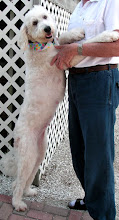
10.  Peachy is a huge Golden Doodle, bigger at 100 pounds than any other we've had.  She to delights us every day of our lives.

11.  Danny was my soul mate, a Border Collie who clearly was the smartest dog we ever had.  He was 9 when his owner died, and we adopted him.  He played catch with me daily, and left us at age 13.

12.  Princess is half Golden Retriever and half something else.  She is white with a faint touch of gold, and she makes us laugh every day.

13.  Nala, a small mixed breed girl, perhaps with a little Dachshund in her and otherwise of unknown provenance.  Not here long, but loved and cherished.

That's quite an inventory of love, devotion, companionship and happiness.  Most could have been purebred judging by their looks, but few came from such fussy backgrounds.  Is the list finished?  I hope not, although Charlene and I have reached an age when we need to downsize our commitments a little.  I do know that if another dog joins our family, it is highly unlikely it will come with "papers."

Les Inglis


Thursday, July 11, 2013


                                                           An Aniplant Clinic


Steps toward a Better Life

The world is hardly rosy and the living is hardly easy for the average Cuban today, but it's better than it used to be, and it's easy to predict still better times ahead.  That’s a hopeful situation for the man on the street and for his dog, who lives on leftovers from his master's table.

Since my first trip there in 2005 I have noticed a creeping improvement in people's lives and in their future prospects.  In 2005 there were lots of rigid rules that restricted the lives of citizens.  For example, a Cuban citizen then could not stay at a first class hotel, although there are many such hotels and they scramble to stay full of tourists from Canada and Europe.  You might say, "Well, Cubans don't have the resources to spend on fancy hotels anyway," and you'd be right for the most part, but the rules hurt anyway.  Those hotels, at least in part, are government enterprises, supposedly owned by the people, but the people couldn't stay in them.

Then a small door opened, and the rules were changed to to allow citizens to stay in the hotels.  This probably only really affected a small percentage of people, but we must crawl before we can walk.  The leaders were on to something, and rule relaxation wouldn't just stop with hotels.  Next, Cubans were told they could have cell phones in a reversal of old strictures.  Well, that was no baby step, and people could soon be seen using them at bus stops, while walking on sidewalks, in parks—you name the place and cell phones were there.  How did they pay for Cuba's high telephone charges?  Well, phone prices and monthly fees were subsidized by loving relatives living in other countries.  Cubans began to save steps, trips, time, and money using the convenience of a phone in your purse or pocket.

When I first visited, paladars (privately owned restaurants improvised from a room in the owner's house) were already feeding tourists, but the rules severely limited their size to 12 seats.  Many paladars were built on the front porch of city houses, but a hard working restaurateur could make much more than the Cuban's average salary of $19.00 US a month.  Like restaurants everywhere, good ones are crowded and poor ones fail, but with a 12 seat limit, Cuba wasn't going to develop any Wolfgang Pucks.

Then, in a wave of relaxation, the government let the paladars expand by killing the 12 seat limit.  The last time I was there, we ate in such an expanded paladar.  It had expanded into several rooms in the basement area also using the original front porch seating.  The place was pretty full, and there was a buzz of conversation, background music, and clinking dishes and glasses that suggested a thriving enterprise.  It doesn't take a Peter Drucker to know that if 12 seats can make money, 50 will make lots more.

But the best was yet to come.  A couple of years back, Cuba finally dumped the myth that the government owned all the houses and cars.  The old rule was that you could live in your house or trade houses with someone else, but it wasn't yours to sell.  If you left the country it would be taken over by the state.  More recently, in a move that surprised many people, a new rule said you could sell the house you lived in and your car (often old US cars from the 1950's), and the money was yours to keep and use.

Wow! All of a sudden many people had a sense of well being and optimism.  In a very few months, driving down the street you could see painters, carpenters, and cement masons at work repairing and sprucing up the houses.  No longer was maintenance deferred because it was the government's responsibility.  Real value was being added, sometimes by sweat equity, and more people were working.  Today, demand for construction work has made their pay better than ever, and the incipient slum look is beginning to disappear from neighborhoods.

There is an old joke among the Cubans that the government pretends to pay its workers (with devalued old Pesos), and the workers pretend to work.  Be that as it may, as workers leave state payrolls and enter a range of permitted private businesses, there's no pretending to work among the entrepreneurs  who are rekindling a growing and productive middle class.

And let's not forget Rover, the family dog, who eats what's left from the dinner table.  Lately he's learned that a rising tide lifts all boats as the quality of his meals improves.

Les Inglis


Saturday, June 29, 2013

                                                               
                                                                        Annie


Dogs in the Sky

For several years we maintained two homes, a non-working farm in Indiana and our house in Florida.  We traveled back and forth from one to the other as the mood struck us.  Until late 1990 the farm was our permanent home and the house in Florida was used for getaways and little vacations.  This was early in our marriage, and Annie was a rescued 15" beagle—our first dog.

We thought it would be unfair to Annie to board her in a kennel during our several trips to Florida each year, so we decided to get a carrier and take Annie with us on the planes.  I must say Annie was a veteran flyer in no time.  She'd walk into the airport on her leash without showing the least sign of apprehension.  We always gave her a long drink of water to last her through the 2 hour flight, and then when it was time, we opened the carrier door and Annie happily and voluntarily walked into the carrier, curled up on the little blanket inside, and prepared for the journey.  After her first flight, she knew what was to be expected, and I'm guessing she slept most of the way, just the way she did on a quiet afternoon at home.

We flew without much worry about Annie.  Granted, riding in the baggage compartment wouldn't be very pleasant for you or me, but Annie had what she needed—a toy, her blanket, and plenty of space in the carrier.  Her carrier rode up the ramp to the luggage area, and sometimes I watched from my window seat on the plane.

One trip back from Tampa to Cincinnati did give us some worries about her safety.  Tampa wasn't the most convenient airport for us—Sarasota was—but Tampa offered non-stop service, and we didn't want to take a chance that she wouldn't get transferred to a second plane in a plane change in Atlanta.  All seemed fine as we checked Annie in, and we watched her ride the conveyer behind the check-in desks into the baggage handling area.  We flew home comfortably knowing Annie was in an air conditioned and pressurized baggage compartment, probably right below our seats.

But when we got to Cincinnati it took much longer than usual for her carrier to appear on the carrousel.  When we finally saw the carrier, we were relieved, but I noticed another baggage tag had been added to the original one.  It seemed she had made the trip to Cincinnati on a different plane from the one we were on.  We never heard why the switch, but since it all ended well, there was no harm done.

I never had any fears she could be lost, as the carrier was well marked with her name and ours.  It also carried a Delta Frequent Flyers' Club tag, which is supposed to get you a little better service on Delta.  Also Annie was never without her collar which had identification tags.  I think that time might have been before microchips.

Many people have mentioned the danger to dogs flying as luggage.  We've all seen the trains of baggage carts baking in the sun on an airport apron.  I'm told live animals get priority treatment by the baggage handlers to avoid overheating them in the summer.  Some airlines serving southern cities will not accept animals in carriers during the summer.

These days we live in one place all the time.  It suits us to be home-bodies, and our dogs are quiet, stay-at-home types.  And it's a good thing too, because these days the airline industry is so huge, impersonal, and computerized that I'm not sure I want to transport the canine members of my family as baggage.

Les Inglis


Saturday, June 15, 2013


The Booster Center

Davis Hawn is an interesting guy.  I first met him via email when he was trying to arrange a trip to Cuba—he'd done some Internet surfing and found the TAP website.  Well, getting to Cuba isn't all that tough, even in view of the US legal restrictions on travel, but Davis had an odd twist on his trip plans—he wanted to take his dog Booster to Cuba with him.

Booster is a service dog, well trained to help Davis with his PTSD.  As a service dog, Booster is with Davis 24-7.  Davis found Booster when he was a stray puppy cowering in the cab when he claimed his pick-up truck from an impound lot.  It was a lucky break for both of them.

Well, we corresponded about his trip and I connected him with Nora at Aniplant.  Her contacts were invaluable to him, and she helped him get a documentary about service dogs filmed and produced in Cuba.  Davis is a very publicity minded person about service dogs, and the documentary was a natural step in his desire to promote the use of service dogs.

Davis adopted a Cuban stray dog he found on Havana's main shopping street, Obispo Street.  He named the dog Fidelity. Nora found Fidelity a foster home for several weeks and got him the veterinary care needed to put him in top certified condition for his eventual trip to the US.  It took some arranging to get Fidelity to the US.  With the help of a couple of fine Canadian-based organizations dedicated to rehoming Caribbean dogs to Canada, Fidelity first flew to Toronto from Varadero.  There he met Davis who flew him to Chicago and eventually to New Orleans near Davis' home.

Booster, being a service dog, needed no such elaborate arrangements.  He didn't even need a travel carrier or to be placed in the baggage compartment for his return from Cuba.  Service dogs, under US law, can travel in the passenger cabin with their owners.  With both of his dogs back home, Davis concentrated on getting his Master's Degree from Bergin University in the San Francisco area. Bergin educates dog trainers, offering a full scholastic program for that purpose.  I was privileged to provide a review of Davis' Master's Degree Thesis.

Now Davis is using his Cuban contacts to start something called The Booster Center in Cuba.  It will be a service dog training organization to help the disabled in Cuba.  Davis has provided scholarships for two Cuban students to prepare themselves at Bergin U. to operate The Booster Center.  Those students, Miguel and Beatriz, are currently in California enrolled in Bergin for that training.  It took two years to make all the arrangements for the students' trips to the US, but after countless emails, they are here and immersed in their studies.

A carefully selected, fully trained service dog is a very valuable animal.  He or she becomes the central object in the life of a person who really needs help with the daily problems of living.  They sense problems and perform tasks like opening doors and provide emotional support and companionship.  If Cuba can develop the Booster Center according to Davis' plans, it will be improving the situations of many people, making their lives more productive and less difficult.

Davis clearly has a knack for building on the age old symbiotic relationship between humans and dogs.

Les Inglis


Sunday, June 9, 2013

Climbing in Cuba
For most of us city dwellers, tall buildings are no big deal.  They abound in cities, and in the normal course of events we never see their stairways.  We use elevators as a matter of course.  Now I've heard of people who voluntarily take to the stairs for several flights to get their exercise, and I can see that would be  a pretty good workout, but it's not for me.  I'll take the elevator every time.
The summer I was 18, it was different.  I took a train to Washington DC for a little sightseeing.  When I got to the Washington Monument, there was a long line of tourists queued up to ride the elevators to the pinnacle, the highest point in the city.  The wait was about two hours.  In those days my energy was only exceeded by my impatience, and I discovered I could bypass the line and use the stairs to get to the top.  I started off two steps at a time.
Well, 555 feet (about the equivalent of a fifty story building) is lots of climbing, and after a few floors I settled down to a more sedate pace, but I eventually reached the top without having to stop to catch my breath.  But that was then and this is now when I couldn't hope to show such endurance.
On my first trip to Cuba I saw how the other half lives.  Havana has its share of tall buildings with the tallest at 37 floors.  Most of the tall ones run about 10 to 15 stories.  In a Communist country, the real estate belongs to the state, and so it is in Cuba.  Along with owning the buildings, the state is responsible for their elevators which in Cuba are under-maintained.  This means that in Cuba at any given time many buildings have non-working elevators as they wait for scant service or repair parts or sometimes complete replacements.
Talk about inconvenience!  To live or work on the eighth floor when the elevator doesn't work can be a big pain in the neck.  Aniplant's headquarters in 2005 and 2006 was an eighth floor apartment in a building with a broken elevator.  It had been that way for a long time, so on my second trip four of us took to the stairs.  I was fifteen or more years older than most of the others, but I kept up with them, and at the top, I was no more worn out than the others.  That experience put helping Aniplant get a new ground floor home at the top of our priorities.
Nora, Aniplant's President, lives in one of the better tall buildings in Havana near the top of the hill in Vedado.  She's on the 10th floor with a great view of the city and the sea and the building (1950's era) has two elevators with spotty service records.  More than once I've encountered elevators that didn't work and had to climb 10 floors with packages of supplies and donations of medicines.  On one trip, the lift was out and Nora told me the building was getting new replacement elevators.  Sure enough at the next trip the new elevators gleamed, free of graffiti and ready to lift silently one and all along with their luggage.
Thanks to broken elevators I've also climbed flights of stairs at Radio Progresso, Cuba's main radio station, more than one office building, and even a few times at my hotel which, at 11 floors was once (in the 1920's) Cuba's tallest building.
When you're visiting Havana you become aware there are fewer obese people in Cuba than there are here at home.  I always thought that was because of high food prices and low food supplies.
Maybe so, but for many it might also be caused by the extra exercise one gets when forced to by-pass broken elevators.
Les Inglis

Saturday, June 1, 2013

Onyx Touches Our Lives
Onyx (is that a great dog's name or what?) is a black lab mix with a shiny coat and sincere eyes that seem to say, "Adopt me, and I'll love you with all my heart every minute of every day for the rest of my life."  And at less than two years of age, Onyx has a lot of love to offer.  His story follows an all too familiar pattern.
Onyx's people were a Miami area family with a 7 month-old baby.  Like lots of short haired dogs, Onyx sheds a bit, and the baby manages to pick up some dog hairs on its clothes.  First they tried leaving the dog in the yard all the time, but then they decided to get someone else to adopt the dog.  In my house no one would notice a few dog hairs, in spite of Charlene's regular, frequent, and energetic cleaning sessions.
Diana became aware of Onyx's plight and surely didn't want him to go to Miami- Dade Animal Control, a practically certain death sentence.  She told her boyfriend, Fernando, another animal lover, and he began a search for a better future for Onyx.
As it happens, Fernando is a nephew of Dulce, a close Cuban-American friend of mine.  Through her I had come to know Fernando who helps us ship boxes of vet medicines to Aniplant in Havana.  Fernando puts lots of effort into those shipments, and he has become an important link in our chain of people who help Cuban animals.  He emailed me about Onyx to see if we could help spread the word.
Charlene carefully reviews Internet postings of dogs needing rescue in the Miami area.  She closely watches a group called My Animals Rock, posted by a retired lawyer named Kathy who has placed hundreds of animals in recent years (including three with our family).  I suggested to Charlene she pass Onyx's information on to Kathy for wider publicity.  Charlene agreed but wasn't too optimistic, pointing out he's large (65 pounds) and black (a disadvantage for dogs needing homes).  My feeling was that Onyx had lots going for him. Like he was neutered, had all his shots, and is good with cats, dogs, children, and babies.  And, Fernando was willing to transport Onyx to any new home in Florida
I think Kathy was a little skeptical too, but she went right ahead and posted his availability after asking for a better photo.  Imagine all of our surprise when within two days of posting, we heard that Onyx had been adopted, moved, and settled into a new home in Palmetto Bay. Florida.  Fernando had done the transport, and he provided a video file with his email that showed Onyx doing laps in his new family's swimming pool.  Like all labs, Onyx loves the water.
There are thousands of stories with sad endings about homeless dogs, but there are also thousands of stories that end with, "happily ever after."  Onyx is well on his way to a happy life with his new big-hearted human companions.
Those persnickety people who were afraid to have dog hair on their baby's clothes don't know the years of joy and love they and their children will be missing.
Les Inglis

Monday, May 27, 2013

Gift Baskets
Some people live their whole lives without finding a stray cat or dog on the front porch.  Those people aren't usually known as animal lovers.  I think it is impossible to be known as an animal lover in one's area without someone eventually deciding to leave an animal at your door clandestinely.
Granted such secretive "gifts may be motivated by a desire to help a homeless animal, but they are also a burden on the recipient, no matter how much he or she loves animals.  Most animal lovers have more than one companion animal—sometimes a few or several.  I'm not talking here about "hoarders" who are mentally ill and have far too many animals.  I'm talking about normal people with a special love for dogs and/or cats.  People like my dear departed mother-in-law and father-in-law who loved all animals and instilled that love into their daughter, my wife, Charlene.
Mary, my mother-in-law, usually had one dog and a few cats.  She and her husband, Ben, cared for all their animals, spent plenty of time with them, and often talked about them with friends.  But Mary and Ben were often victimized by others who might dump a cat or a few new kittens at their house.  Each time they found a box or basket at the back door, they had to care for the new arrival(s), feed them, and try to find a friend who might want to adopt it.  That meant they usually had a few more animals than they could reasonably support.
In our own case, although I can't prove they were dumped, over the years we have encountered several cats hanging around our house.  This happens with a frequency that leads me to suspect some of them may have been unrequested midnight deliveries.  As a result, we have averaged about 6 cats in our house over the 24 years we have lived here.  It was the same at our farm before we moved here, but the number of strays in that area was always large.
What's the alternative if you find a dog or cat?  Well, first decide if you have room in your life for a new companion.  Do you have any friends who might like to adopt a lifelong pal?  Also, consider a local shelter or refuge.  Yes they are usually full, and some must euthanize animals to control the number they keep, but, assuming the shelter practices humane euthanasia, that is neither cruel nor unfair in this imperfect world.  What does seem unfair is to leave an animal at someone's door just because that person loves animals.
I'm saying that when you encounter a homeless animal you should do everything possible to get it into a caring home.  Charlene's mantra is "Never be too busy to help an animal in distress."  And she lives by that Commandment without exception. But beyond animals found along the roads or in the occasional picture of a rescued dog in foster care that we fall in love with, we really don't need surreptitious additions to our menagerie.
Every animal adopted by loving, sensible people is one less animal at risk of injury, sickness, or starvation.
Les Inglis